Accurate cell and nuclei counts are critical for CUT&RUN, CUT&Tag, and related assays, but one common challenge is distinguishing cells/nuclei from debris when using trypan blue. (Note: for tissue and/or frozen samples, we recommend using propidium iodide (with acridine orange) rather than trypan blue. See this article for more information on working with PI.)
Note: we strongly recommend counting with an automated cell counter, like the Countess (Thermo Fisher). Counting manually and/or relying on the cell counts produced by a FACS-sorting machine can result in inaccurate estimates.
How does trypan blue stain present?
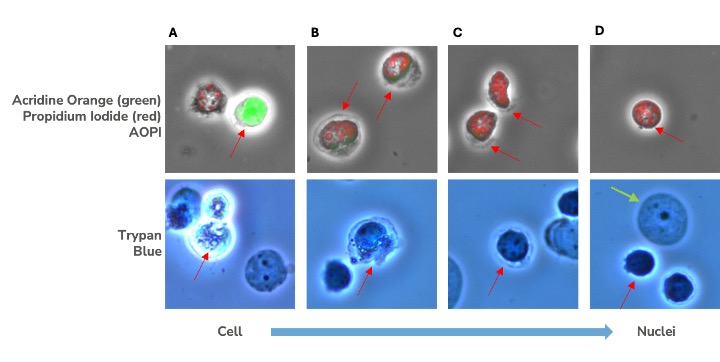
Figure 1. AOPI- and trypan blue-stained examples of cells in varied states of nuclei extraction. A) Intact cells prior to nuclei extraction. White halo around cell body = alive, non-permeable cell membrane. Nucleus of cell should not be blue. B) Failed nuclei extraction leaves permeable and dying cells. C) Partial nuclei extraction: cell membrane (arrow) remains. D) Red arrows: complete nuclei extraction. Green arrow: swollen nuclei—should be <20% of sample.
For more on trypan blue staining in general, see this article.
Why do I see excessive debris after nuclei extraction?
What appears to be debris is often trypan blue precipitation, not cellular material—however, the presence of this precipitation can still make counting difficult. Trypan blue can precipitate under several conditions:
High salt concentrations (e.g., 10X PBS) (Figure 2).
Excess spermidine
Delayed counting after trypan blue addition: even when salt concentrations are low, precipitation may occur if samples are left sitting for approximately 10 minutes after trypan blue is added. EpiCypher’s Nuclei Extraction Buffer (EpiCypher 21-1026) does not typically cause trypan blue precipitation when samples are counted within 10 minutes.
Recommendations for Accurate Counting
Count samples promptly: after adding trypan blue, count your cells or nuclei as soon as possible. Delays can allow trypan blue precipitates to form, which may lead to inaccurate counts.
Before use, incubate trypan blue in a 37C water bath/heat block, and then centrifuge for 30 seconds.
Be sure you are pulling trypan blue from the top of the solution.
Trypan blue can be syringe-filtered (0.22 um) if there is growth or persistent precipitate after warming.
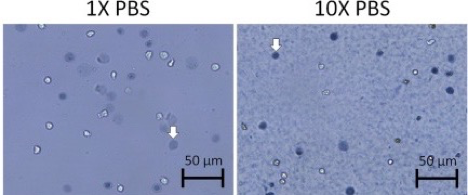
Figure 2. Trypan blue-stained nuclei in 1X PBS (left) are easier to count than trypan blue-stained nuclei in 10X PBS (right), because the higher salt concentration of the 10X PBS causes the trypan blue to precipitate.