The recommended starting material depends on the assay you are performing.
Fiber-seq
Use nuclei. See our Fiber-seq articles for more information on nuclei isolation and minimum input required.
CUT&Tag
Use nuclei. While cells can technically be used as input to CUT&Tag, pAG-Tn5 transposases can tagment mitochondrial DNA, which tend to eat up sequencing reads at the expense of target genomic reads. Using nuclei helps reduce mitochondrial sequencing reads and maximizes usable data.
CUT&RUN, meCUT&RUN, and Multiomic CUT&RUN
For most sample types, CUT&RUN, meCUT&RUN, and Multiomic CUT&RUN assays can be performed using either whole cells or isolated nuclei. While many samples work well with either input, certain sample types consistently perform better with nuclei. The guidelines below can help you determine which input is best for your experiment.
When Should I Use Whole Cells for CUT&RUN-Based Assays?
When you are working with:
Suspension cell lines (e.g., K562, Jurkat).
Cultured adherent cell lines that can be gently dissociated into a healthy single-cell suspension.
Fresh primary cells with high viability and intact morphology.
Limited starting material: if only a small number of cells are available and nuclei isolation is not required for your sample type, using whole cells may maximize sample recovery by minimizing handling steps.
Samples that have been previously produced robust CUT&RUN data using whole cells.
When Should I Use Nuclei for CUT&RUN-Based Assays?
When you are working with:
Immune cells: immune cells often contain cytoplasmic granules, lysosomes, and phagosomes that may interfere with CUT&RUN. Isolating nuclei removes these structures from your sample prep and can also minimize unintended cell activation during ConA bead binding, particularly in T cells.
Frozen tissues: cell membranes are often compromised during freezing and thawing, while nuclei typically remain intact and can be isolated more reliably. For more on sample prep for tissues, see our section on working with tissue.
Difficult-to-dissociate samples: consider using nuclei when working with samples that are:
Difficult to count accurately
Highly adherent
Rich in extracellular matrix
Difficult to dissociate into a single-cell suspension (e.g., neuronal or adipose tissue)
When you have already tried using cells: If you have observed excessive clumping, sample loss, or suboptimal CUT&RUN results using whole cells, consider switching to isolated nuclei.
Considerations When Using Nuclei for CUTANATM-Based Assays
Nuclei are inherently sticky, so some amount of sample clumping is expected. Excessive clumping, however, is not normal and will result in poor data (Figure 1).
If you are crosslinking, it is recommended to do so prior to nuclei extraction, to minimize the chance that the chromatin landscape is altered by the process of crosslinking itself.
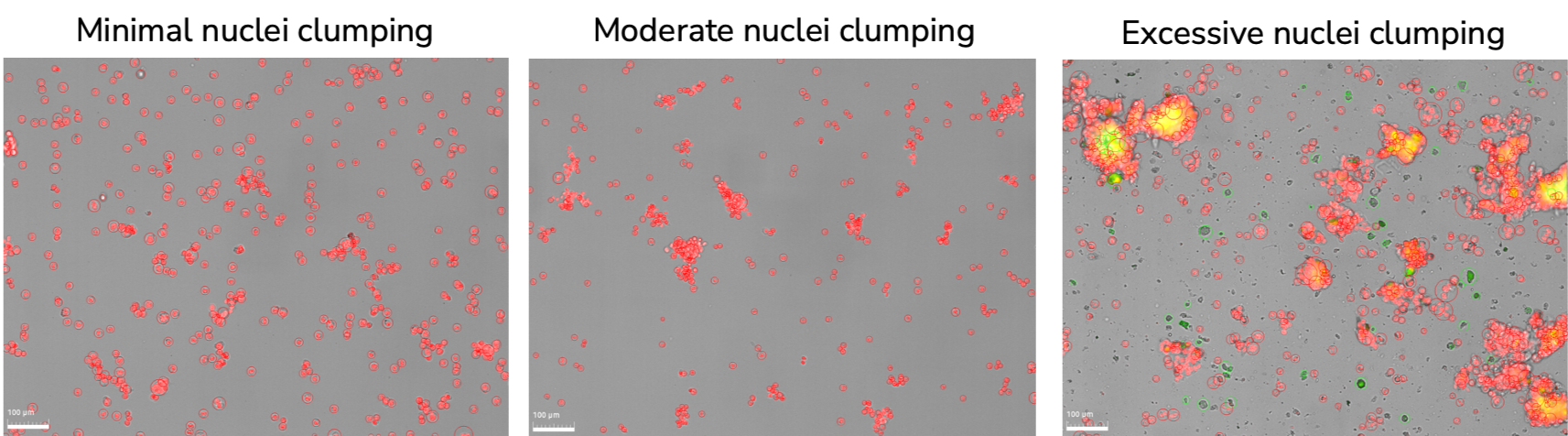
Figure 1. Isolated nuclei stained with AOPI menonstrating minimal (left), moderate (middle), and excessing (right) clumping. Increased clumping within your sample will limit your ability to accurately quantify and dispense the sample across your reactions. It may also impact permeabilization and the ability of the antibody and enzyme to access the chromatin in all nuclei.