EpiCypher has validated the use of the CUTANATM ATAC-seq Kit with 1,000 to 50,000 human nuclei, generating comparable and robust open chromatin profiles across input levels (Figure 1). For novel sample types with limited starting material, we recommend validating workflow performance with an input titration to determine the lowest input which reliably generates robust ATAC-seq data before routine use.
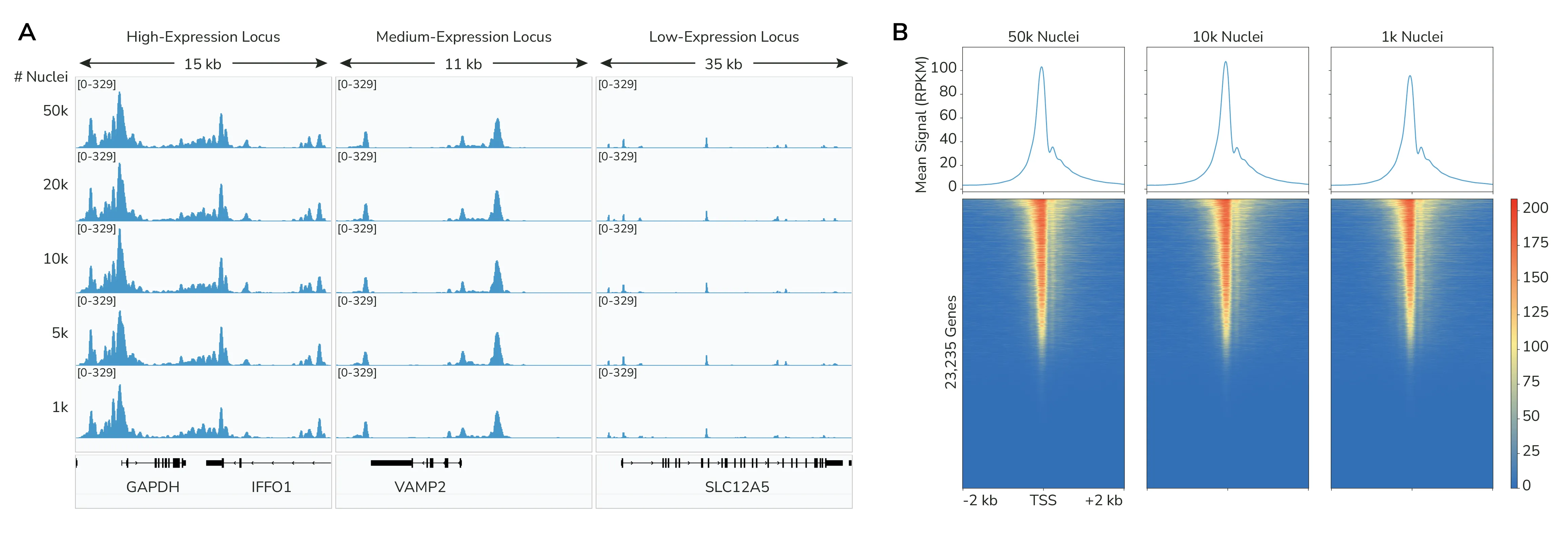
Figure 1. The CUTANA ATAC-seq Kit enables chromatin accessibility profiling with low nuclei inputs. Reactions using 1,000–50,000 K562 nuclei produced comparable data. (A) Representative genome browser tracks. (B) Genome-wide heatmaps show consistent signal relative to Transcription Start Sites (TSSs) with decreasing number of nuclei. Rows are aligned across all reactions.
Experimental set up for input titration:
After confirming integrity and quantity of extracted nuclei (at the end of Section II: Nuclei Extraction in Manual), on ice, prepare a serial dilution of input nuclei in cold 1X PBS to achieve targeted number of nuclei in 10 µL per reaction.
Perform tagmentation as instructed by kit protocol using 5 Units of Tn5 Transposome (2.5 µL of the 2 U/µL stock) for each reaction.
Proceed with kit protocol for post-tagmentation cleanup and PCR amplification.
Optimization tips and tricks:
Lower library yields are expected with lower-input samples; these are acceptable if they meet sequencing requirements (≥0.5 nM).
If library yield is too low to sequence, consider increasing PCR amplification cycles up to ~15 cycles for lower-input samples. However, additional PCR amplification and lower starting complexity can result in a higher rate of duplicate sequencing reads.
If library TapeStation traces show over-tagmentation, perform a serial dilution of Tn5 Transposome with Enzyme Diluent (provided in the kit) fresh on the day of the experiment to lower the Units of enzyme used per reaction. Ensure 2.5 µL of enzyme are added to each tagmentation reaction, regardless of dilution. See this article for more troubleshooting guidelines with suboptimal ATAC-seq TapeStation traces.