Conconavalin A (ConA) beads are a critical reagent in CUTANA™ assays but can become inactivated through drying, freezing, or improper handling. Once damaged, ConA beads cannot be rescued and should not be used for CUTANATM assays. If you suspect that your beads are compromised, contact techsupport@epicypher.com before beginning your assay. The Tech Support team may ask for images of the bad beads, so do not immediately dispose of the beads, and take photos when possible.
What should ConA bead stocks look like?
If your ConA bead stocks have been stored at 4°C according to the kit instructions, they should resemble one of the examples shown in the top row of Figure 1. After dilution to the working concentration for cell/nuclei binding, they should resemble the bottom row of Figure 1.
How can I tell if my ConA beads are compromised?
Compromised ConA beads are best identified before beginning a CUTANA™ assay by inspecting the stock tube. Good bead stocks should resemble Figure 1A, whereas compromised bead stocks typically exhibit Figure 1B. If compromised beads are not identified before use, they can also be identified by abnormal behavior during cell or nuclei binding. Working beads bind uniformly to cells/nuclei (Figure 2A), whereas compromised beads form aggregates that cause bead and nuclei clumping (Figure 2B), which can negatively impact assay performance.
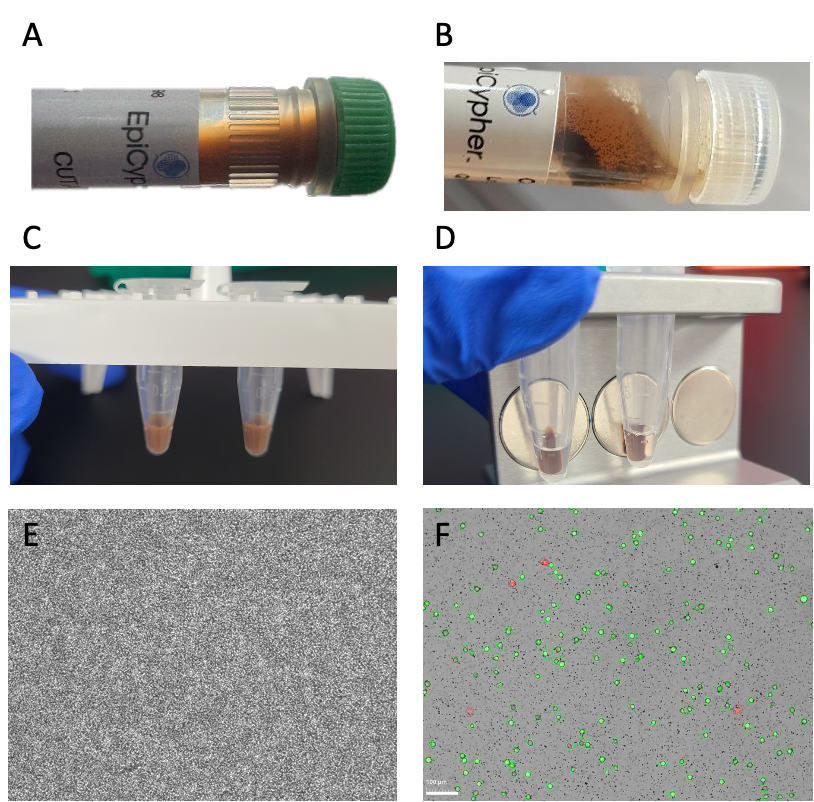
Figure 1. Example of ready to use ConA beads in the stock tube (A), in a microcentrifuge tube (C) and on a magnetic rack (D). The suspension should appear uniform, dark brown, with no settling, precipitate, or dried residue on the sides of the tube. Example of compromised ConA beads in the stock tube (B). The beads have settled out of solution, forming a “coffee grounds” appearance, and cannot be resuspended via standard methods (pipetting, gentle vortexing). (E)Undiluted ConA beads under 20x magnification. (F) Diluted ConA beads bound to stained live cells.
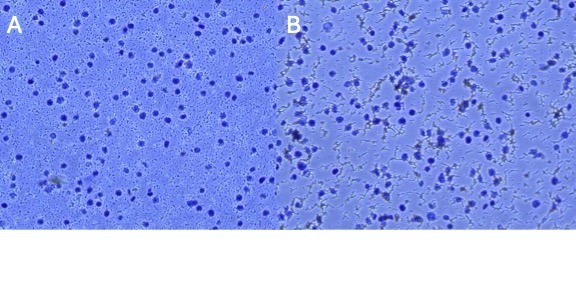
Figure 2. A) Good ConA beads bound to nuclei. Note uniform distribution and presence of multiple beads around each nucleus. B) Compromised ConA beads bound to nuclei. Note bead aggregation and clustering of nuclei caused by bead clumps.
Important note: When working with nuclei, some clumping is normal and should not be mistaken for compromised ConA beads. Learn more about expected nuclei clumping here.